Skip to content


People often ask me whether Yoga Nidra is a form of meditation, a relaxation technique, or simply a way to fall asleep.
The honest answer is that it is a little difficult to fit Yoga Nidra neatly into any one category.
The term itself means “yogic sleep,” but Yoga Nidra is not really sleep in the way most of us understand it. During a practice, the body becomes deeply relaxed, sometimes so relaxed that it feels as though it has fallen asleep. Yet some part of awareness remains quietly present.
This is what makes Yoga Nidra so unique.
In a typical practice, you lie down comfortably, close your eyes, and follow a series of simple instructions. There is no posture to perfect, no breathing technique to master, and no expectation that you should stop thinking. Instead, attention is gently guided through the body, the breath, sensations, and awareness itself.
Over the years, I have found that many people come to Yoga Nidra because they are exhausted. They are tired of trying to relax, tired of trying to meditate, and often tired of trying to sleep. What surprises them is that Yoga Nidra does not ask them to try harder. It asks them to let go of effort altogether.
From a traditional yogic perspective, Yoga Nidra is a practice of conscious rest. It allows the body to enter profound relaxation while the mind remains quietly observant. This state, somewhere between sleeping and waking, has been explored in yogic traditions for centuries.
Today, many people describe Yoga Nidra as a form of conscious deep rest. I still prefer the traditional understanding: it is a practice of learning how to rest fully while remaining aware.
And in a world where most of us have forgotten how to rest at all, that may be one of its greatest teachings.
Table of Contents
Origins of Yoga Nidra
Although the practice has become increasingly popular in recent years, its roots extend deeply into traditional yogic philosophy.
Its foundations lie within the broader tradition of yoga, particularly in the practice of pratyahara, the gradual withdrawal of awareness from the external world toward inner experience. In traditional yogic understanding, the states between waking and sleeping were not viewed simply as periods of rest, but as opportunities for observation, restoration, and expanded awareness.
The modern form taught around the world today was largely developed and systematized by Swami Satyananda Saraswati, founder of the Bihar School of Yoga and a disciple in the lineage of Swami Sivananda Saraswati. Drawing upon traditional yogic and tantric practices, he created a structured method that made these teachings more accessible while preserving their philosophical depth.
In my own experience, this traditional understanding has always felt important. The practice was never intended to be merely a relaxation technique or a way to fall asleep more easily. Rather, it was developed as a method of conscious awareness, simply learning how to remain present while the body enters profound states of rest.
Traditional teachings also incorporate the practice of sankalpa, a personal intention or heartfelt resolve. Rather than functioning as a goal or affirmation, a sankalpa serves as a quiet reminder of deeper values and intentions of the individual, introduced when the mind is especially receptive.
Today, this ancient practice is explored by people from many different backgrounds and for many different reasons. Yet despite modern adaptations and growing scientific interest, its central teaching remains remarkably simple: deep rest and awareness do not have to be separate experiences.
How Does Yoga Nidra Work?
One of the questions I am asked most often is how a practice that appears so simple can feel so deeply restorative.
Part of the answer lies in something that traditional yogic practitioners understood long before modern neuroscience began studying the relationship between the body and the brain: the mind and body cannot truly be separated.
In traditional Yoga Nidra, awareness is systematically guided through different parts of the body in a specific sequence. To a beginner, this may seem like a simple exercise in attention. Yet over many years of practice and teaching, I have found that this rotation of awareness is one of the most important elements of the practice.
Modern neuroscience offers an interesting perspective on why this may be the case. Researchers have demonstrated that every part of the body is represented within the sensory and motor regions of the brain. In fact, certain areas, such as the hands, face, lips, and fingers which occupy disproportionately large areas on the sensory map of the brain.
This becomes especially interesting when we consider that these same areas receive particular attention during traditional Yoga Nidra practice.
Rather than attempting to relax the mind directly, the practice begins with awareness of the body. As attention gradually moves through different regions, physical tension often begins to soften. Breathing becomes quieter. Mental activity slows. In this way, the mind is calmed through the body rather than despite it.
This is why so many people find the practice unexpectedly powerful. They discover that relaxation is not something they need to force. When attention is guided skillfully, the body often remembers how to rest on its own.
This understanding becomes increasingly important when we consider stress, sleep, recovery, and healthy aging. Much of modern life keeps the nervous system in a prolonged state of activation. Practices that encourage conscious rest and nervous system recovery may therefore play an important role in supporting resilience, restoration, and long-term well-being.
Benefits of Yoga Nidra
One of the most widely recognized benefits of yoga nidra is its ability to support relaxation and help counter the effects of chronic stress.
Traditional yogic teachings understood long ago what modern stress research has increasingly confirmed: the body cannot remain in a constant state of alertness without consequences. Much of modern life keeps the nervous system activated for prolonged periods of time. Over time, this may affect sleep, recovery, emotional balance, concentration, and overall well-being.
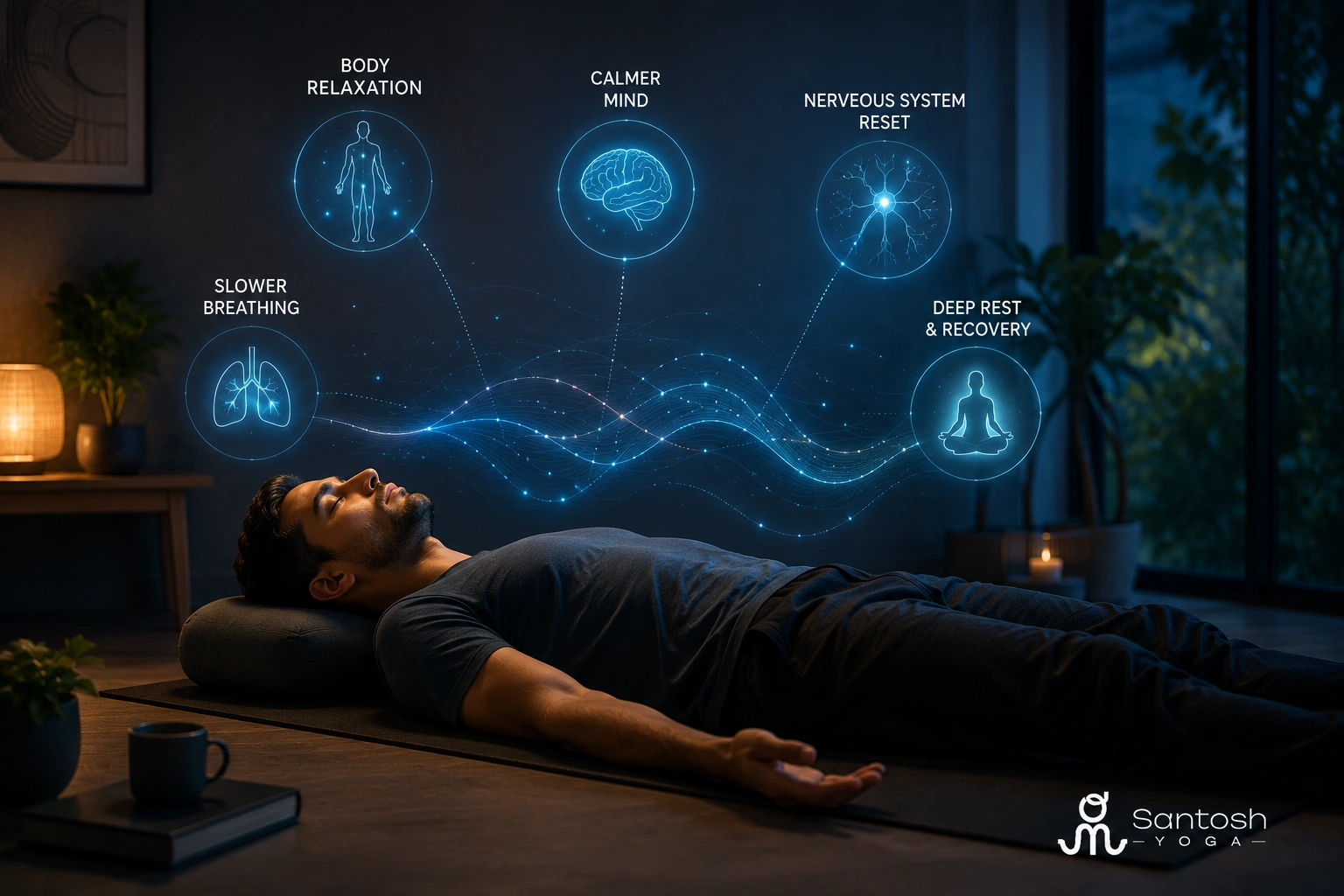
The practice works by encouraging a state that many researchers now describe as the relaxation response, the physiological counterpart to the well-known “fight or flight” response. As the body relaxes, breathing often becomes slower, muscular tension decreases, and the nervous system shifts toward restoration and recovery.
Research exploring these effects has observed changes in physiological markers associated with stress, including heart rate, blood pressure, and stress hormones such as cortisol and adrenaline. While scientific understanding continues to evolve, these findings closely mirror what traditional yogic practitioners have observed for generations: when the body enters deep rest, its natural capacity for restoration begins to emerge.
Many practitioners report benefits such as:
- Greater feelings of calm and emotional balance
- Improved sleep quality and easier transitions into rest
- Better recovery from physical and mental fatigue
- Reduced feelings of stress and overwhelm
- Improved concentration and mental clarity
- Greater resilience during challenging periods of life
- A deeper sense of self-awareness and inner steadiness
In traditional teachings, however, the purpose of the practice extends beyond simply managing stress. The ancient yogis developed these methods not merely to help people cope with difficult circumstances, but to help them cultivate greater awareness, resilience, and clarity in the midst of challenges of life.
This perspective feels particularly relevant today. The goal is not simply to escape stress, but to develop a different relationship with it.
.If you would like to explore these effects in greater depth, you can read our complete guide to the Benefits of Yoga Nidra.
Yoga Nidra vs Meditation
One of the most common questions I hear is whether Yoga Nidra is simply another form of meditation.
The answer is both yes and no.
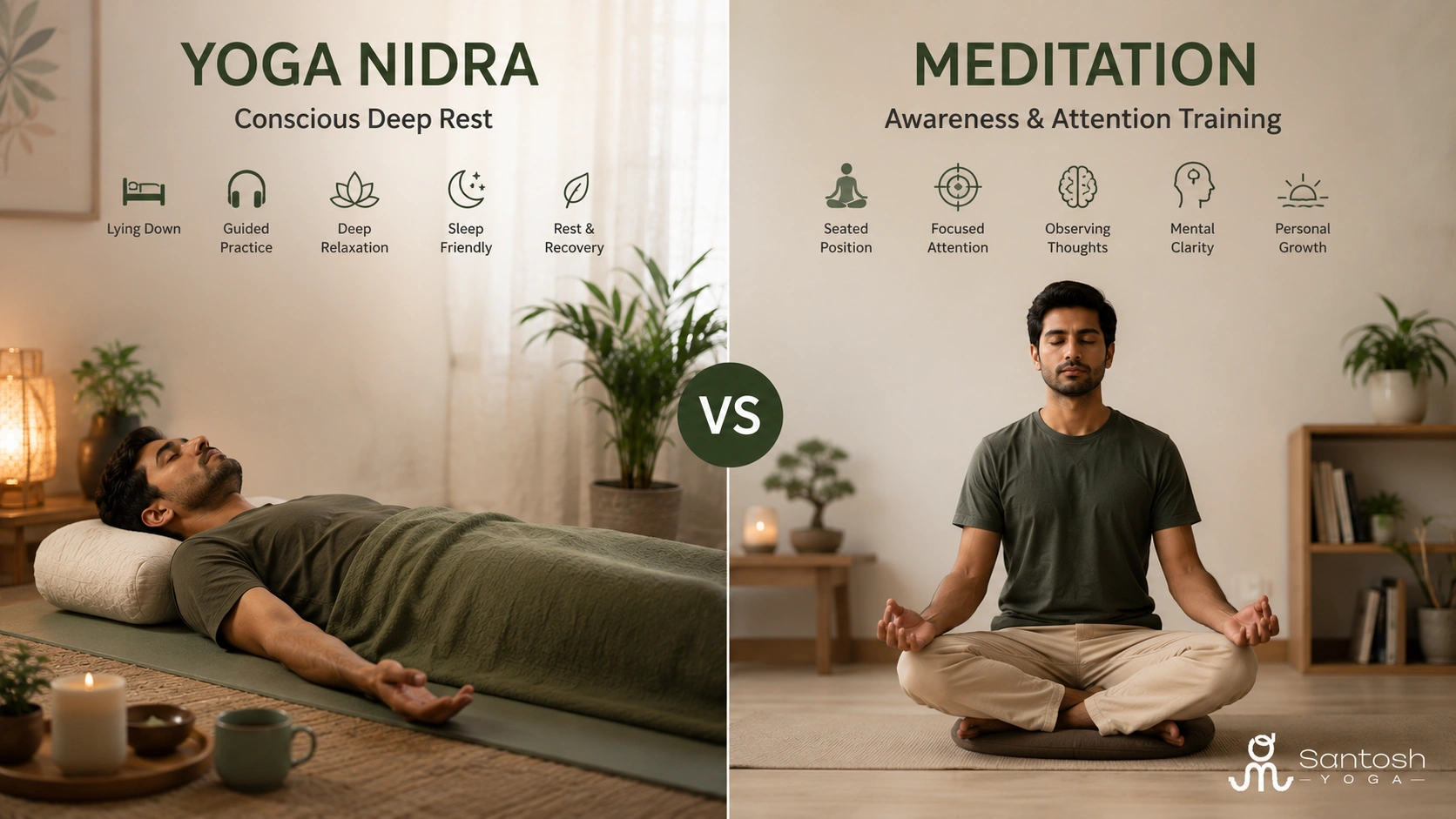
Meditation often trains awareness through attention, while Yoga Nidra teaches awareness through relaxation. Neither approach is better than the other; they simply serve different purposes.
| Feature | Yoga Nidra | Meditation |
| Position | Usually lying down | Usually seated |
| Effort | Passive and guided | More active and self-directed |
| Primary Goal | Deep rest and awareness | Attention and mindfulness |
| Guidance | Usually guided | Often self-guided |
| Physical Demand | Minimal | Minimal to moderate |
| Experience | Conscious relaxation | Conscious observation |
| Suitable for Beginners | Very accessible | May require practice |
Traditional yogic teachings do not necessarily separate these practices as strictly as we often do today. In fact, Yoga Nidra can be understood as a preparation for deeper states of meditation by helping the body relax and the mind become less reactive.
Who Can Benefit From Yoga Nidra?
One of the reasons I have continued teaching Yoga Nidra for so many years is that I have rarely encountered anyone who could not benefit from learning how to rest more deeply.
Although people often begin practicing for different reasons, the underlying experience is usually similar: the body is tired, the mind is overstimulated, and rest no longer comes easily.
Stressed Professionals
Many professionals spend their days moving from one task to another without ever fully switching off. Even after work ends, the mind often continues planning, analyzing, and worrying.
For people living in a constant state of mental activity, the practice can provide a structured way to step out of the “fight or flight” mode and experience genuine rest.
People Struggling With Sleep
Many individuals who experience difficulty falling asleep or staying asleep discover that the problem is not a lack of tiredness, but an inability to relax.
Because the practice helps create conditions for deep relaxation, many people explore yoga nidra for sleep as part of their evening routine and overall approach to better rest.
People Experiencing Burnout
Burnout often feels like a paradox: profound exhaustion accompanied by an inability to stop thinking.
Many people experiencing burnout respond well to practices that require very little effort. Rather than asking the body and mind to do more, Yoga Nidra offers an opportunity for recovery through conscious rest.
People Experiencing Anxiety or Mental Restlessness
When the mind feels overwhelmed, traditional meditation can sometimes feel difficult or even frustrating.
Because attention is gently guided throughout the practice, many people find it easier to remain engaged without feeling pressured to “clear the mind” or stop thinking.
Athletes and Active Individuals
Recovery is an essential part of physical performance.
Many athletes and physically active individuals use guided deep rest practices to support recovery, improve body awareness, and create periods of intentional restoration between training sessions.
Older Adults
As we age, maintaining good sleep, emotional balance, stress resilience, and overall well-being becomes increasingly important.
One of the strengths of this practice is that it requires no physical exertion, flexibility, or previous experience, making it accessible to people at virtually every stage of life.
Ultimately, the people who benefit most are often those who feel they have forgotten how to rest. In a world that constantly asks us to do more, Yoga Nidra offers an opportunity to experience something increasingly rare: deep rest without effort.
How to Practice Yoga Nidra
You do not need flexibility, physical strength, previous meditation experience, or even prior knowledge of yoga. In fact, one of the central principles of traditional practice is that the less effort you make, the more easily the experience unfolds.
A typical session usually lasts between 20 and 40 minutes, although shorter practices can also be effective. For beginners, the easiest way to start is by following a guided recording.
Create a Quiet Space
Begin by finding a place where you are unlikely to be interrupted.
The room should be comfortable, quiet, and free from unnecessary distractions. Traditional teachings recommend a space that is neither too bright nor completely dark, allowing the mind to remain relaxed while still maintaining awareness.
You do not need a dedicated meditation room. A bedroom, living room, or any quiet space where you feel safe and comfortable is sufficient.
Lie Down Comfortably
Traditionally, the practice is performed in Shavasana, or Corpse Pose.
Lie flat on your back with your legs comfortably apart and your arms slightly away from your body. Turn the palms upward and allow the fingers to relax naturally. If needed, use a thin pillow or blanket to support the body and maintain comfort throughout the practice.
Follow Guided Instructions
Once the practice begins, simply listen.
Allow your attention to move where it is guided, through the body, the breath, sensations, and visualizations. There is no need to concentrate intensely, control your breathing, or try to force relaxation.
Allow Awareness to Rest
The intention of the practice is not to fall asleep, although sleep may sometimes occur, especially in the beginning.
Instead, the aim is to remain gently aware while the body enters a state of profound relaxation.
If your thoughts wander, that is normal. If you become deeply relaxed, that is normal too. The practice does not require perfection. It simply asks that you allow yourself to rest without striving.
Can Yoga Nidra Help With Sleep and Recovery?
One of the main reasons people discover Yoga Nidra is because they are tired, but unable to truly rest.
They may be physically exhausted yet mentally alert. They may fall asleep easily but wake frequently throughout the night. Or they may simply feel that they never fully recover, regardless of how much they sleep.
This is where many people begin exploring yoga nidra for sleep.
Many practitioners find that an evening practice becomes a bridge between the demands of the day and the experience of sleep itself.
Research exploring Yoga Nidra and sleep has also produced encouraging findings. A randomized controlled trial involving individuals with chronic insomnia observed improvements in subjective sleep quality, total sleep time, and deep sleep stages following regular practice.
Beyond sleep, the practice may also support recovery.
Whether practiced before bed, after periods of stress, or during times of physical and mental fatigue, Yoga Nidra offers something many people are missing: permission to pause, recover, and rest deeply.
Experience Traditional Yoga Nidra
If you would like to experience how traditional Yoga Nidra can support recovery, emotional balance, nervous system health, and healthy aging, I invite you to explore our 45-minute Yoga Nidra for Longevity session.
Created from decades of traditional practice and teaching experience, this guided experience is designed to help you integrate deep rest into your daily life.
Explore Yoga Nidra for Longevity and begin your practice today.
Frequently Asked Questions
What is Yoga Nidra in simple words?
Yoga Nidra is a guided practice of deep relaxation in which the body rests while awareness remains gently present. It is often described as “yogic sleep,” although the goal is not necessarily to fall asleep.
Is Yoga Nidra actual sleep?
No. Although many people feel as though they have been asleep, the practice aims to maintain awareness while the body enters a deeply relaxed state. Some beginners do fall asleep occasionally, which is completely normal.
Can beginners practice Yoga Nidra?
Yes. One of the greatest strengths of Yoga Nidra is that it requires no previous experience, flexibility, physical effort, or meditation training.
How long should Yoga Nidra sessions be?
Most sessions last between 20 and 40 minutes. Beginners often find that shorter sessions are easier to start with, while experienced practitioners may prefer longer practices.
Can Yoga Nidra help with stress?
Many practitioners use Yoga Nidra to support relaxation and recovery during periods of stress. Research continues to explore how guided deep rest practices may influence stress physiology and nervous system regulation.
Is Yoga Nidra safe for everyone?
For most healthy individuals, Yoga Nidra is considered a gentle and accessible practice. Those with specific medical or psychological conditions should consult an appropriately qualified healthcare professional if they have concerns.
Can Yoga Nidra improve sleep?
Many people report that practicing Yoga Nidra before bedtime helps them transition more easily into sleep and feel more rested overall. Research investigating Yoga Nidra and insomnia has also produced encouraging findings.
What if I fall asleep during the practice?
This is extremely common, especially when beginning. While traditional practice encourages maintaining awareness, occasional sleep is not considered a failure. With regular practice, many people naturally become more aware while remaining deeply relaxed.
Conclusion
After decades of practicing and teaching traditional Yoga Nidra, I have come to believe that many people are not simply looking for relaxation. They are looking for a way to rest deeply, consciously, and without striving.
What makes this practice so remarkable is its simplicity.
You simply allow yourself to rest.
In a world that increasingly values constant activity, Yoga Nidra offers something both ancient and deeply relevant: the possibility of conscious rest, nervous system recovery, and a more balanced relationship with ourselves.
If you are curious about experiencing this practice for yourself, I invite you to begin with a guided session and discover what deep rest can feel like when nothing is required except awareness.